Developer Logs
Basics #
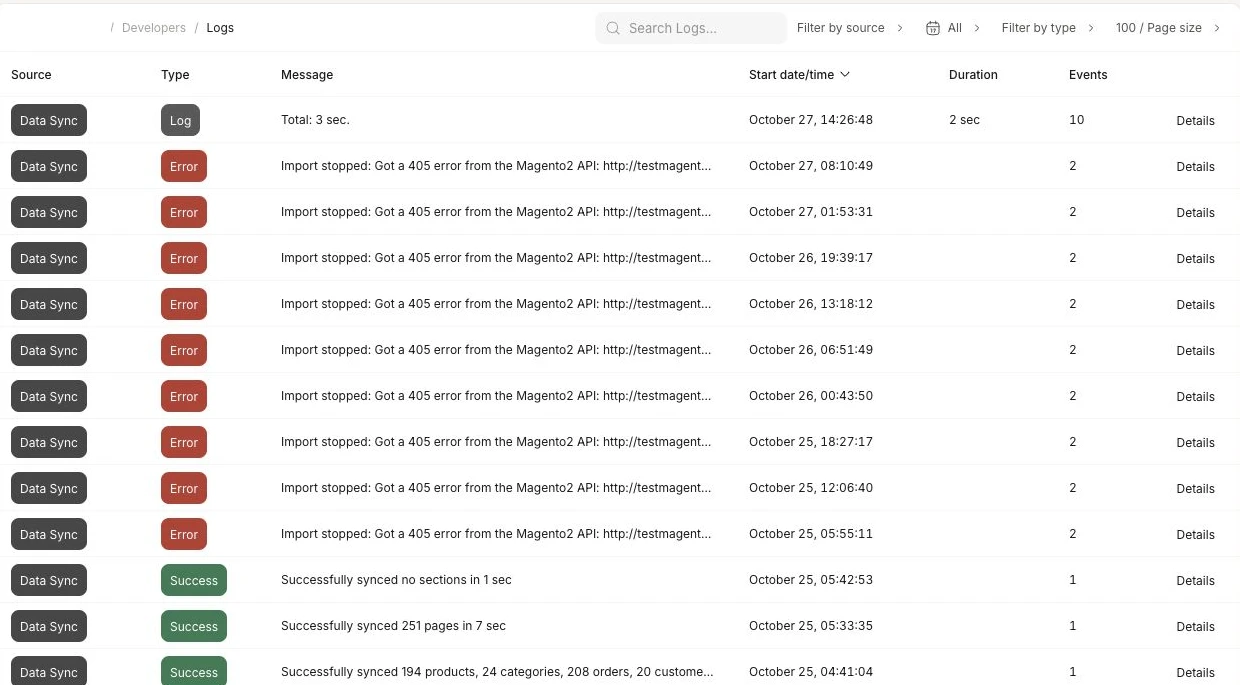
Developer Logs help you debug integrations and client‑side usage. You can see requests coming from your site and apps, filter by type, and drill into the details to spot issues quickly.
Find it in my.clerk.io under Developers > Logs for the Store you are working on.
Filter logs #
Choose the time range, Source and Type to narrow the log list. Use Source for an area such as Data Sync, and Type for a severity such as Error or Warn.
Combine these filters with the search field when you need a particular message, endpoint or identifier.
Read the overview #
The overview groups related events into log periods. Each row shows its start date/time, duration and event count. A period can contain one event or a sequence of events.
Open a period to see its events, then open an event to inspect its details. Use the grouping explanation in the period view to understand that period’s boundaries.
Read an event #
The event message is the main heading. Source and type labels and the event’s readable date/time appear with it.
Event details contains structured fields, including available IDs, URLs, errors and payload data. Use these details when reporting a problem.
Empty states #
If no entries match your filters, you’ll see a clear empty state with suggestions to adjust filters or time range.
Tips #
- Use Error and Warn during rollouts; switch to Info/Debug for deeper investigations.
- Open an event and use its details when reporting a problem. Share only the information needed to explain it; remove credentials and unrelated personal data.